About the project
In a bid to minimise the reliability on non-renewable energy sources, the Government of Mauritius has taken bold commitments to increase its share of Renewable Energy (RE) on the national grid to 60% by 2030. In the furtherance of this initiative, the Government of Mauritius has embarked on an ambitious programme with various stakeholders whereby the Central Electricity Board (CEB) has been entrusted with the execution of the United Nations Development Programme/Global Environment Facility (UNDP/GEF) funded ‘Removal of Barriers to Solar Photovoltaics (PV) Power Generation in Mauritius, Rodrigues and Outer Islands’, which was approved in 2011.
The project is designed to offer a systematic approach to removing associated market barriers to investments in RE, more specifically solar PV in Mauritius, Rodrigues and the Outer Islands. Solar PV, with the largest share of electricity generated from RE (49%, 154.5 GWh out of 315.5 GWh in 2022) and the highest grid penetration rate (from 17.74 MW in 2014 to 108 MW in 2022) over the years, represents the key leading technology for green electricity production in Mauritius. Moreover, the rapidly and continuous falling costs of the solar PV technology have contributed to the competitive edge of the technology in contrast to its peer RE technologies as well as non-RE sources of energy.
Additionally, with the anticipated decrease in the Levelised Cost of Electricity (LCOE) of solar PV due to ongoing technological advancements in the field, the current installed solar PV capacity is expected to further increase in the coming years. The Government of Mauritius had already announced in the budget speech 2023-24 that the installation of an additional 85 MW of solar PV is expected by July 2024. Nevertheless, in order to optimise the aforementioned initiatives, proper assessment of incident solar resources should be carried out to ensure strategic siting of solar PV plants. To that end, solar maps derived from in-situ insolation data prove to be a crucial tool. As such, a solar map for Mauritius can be reliably used to identify sites with the highest incident insolation for solar PV plants so as to maximise the energy production while enabling proper technical as well as financial appraisal of solar PV systems at design stage. Modelling and simulation of solar PV systems requires certain meteorological data such as daily solar insolation, peak irradiance values as well as temperature variations to analyse the behaviour of the system. These meteorological data can only be acquired through high-precision on-site measurements of solar radiation under the local environmental conditions. Consequently, under this project, the services of the University of Mauritius (UoM) were solicited for the development of a Solar Map for Mauritius and a memorandum of agreement was signed in November 2016 between the UoM and CEB to that effect. The objective of this project is to develop a free online GIS Solar Map accessible to general public which the solar PV industry may leverage on for the optimal and strategic integration of solar PV in the national electrical grid.
Key Project Members
The key project members are provided at the table below.
Organisation | Project Member | Designation |
|---|---|---|
United Nations Development Programme (UNDP) | Mr. Satyajeet Ramchurn | Environment Programme Officer |
| Central Electricity Board (CEB) | Mr. Mohammed Shamshir Mukoon | Project Director |
Mr. Mahomed Ally Zabee-Ullah Rujbally | Project Manager | |
Mr. Ahmad Iqbal Dreepaul | Project Manager | |
| University of Mauritius (UoM) | Dr Yatindra Kumar Ramgolam | Coordinator of Project |
Mr. Nûr Khan Juhoor | Research Assistant | |
Dr Aatish Chiniah | Team Member | |
Dr Manta Devi Nowbuth | Team Member | |
Dr Yogesh Beeharry | Team Member | |
Mr Kaviraj Bangarigadu | Team Member | |
Mr Sandy Ramiah | Team Member |
Equipment
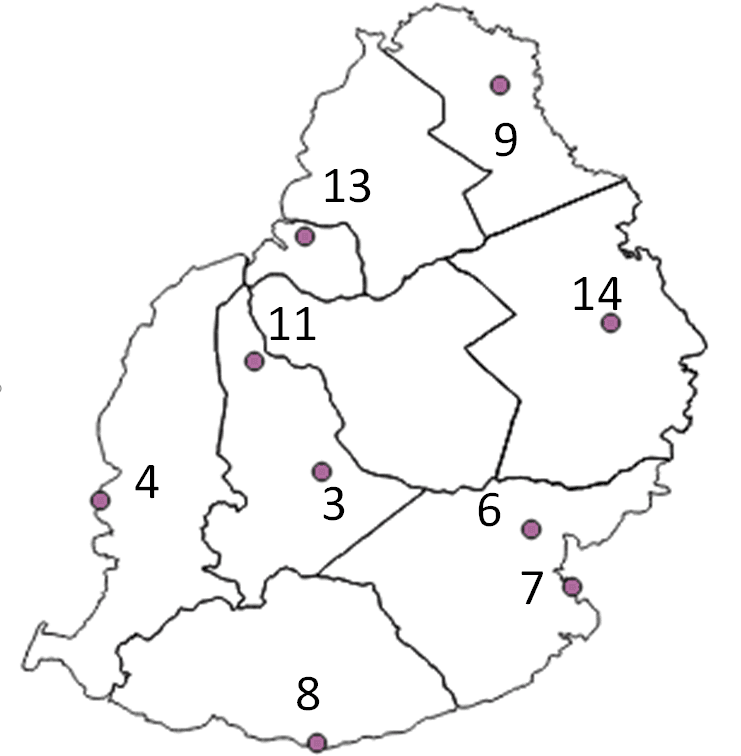
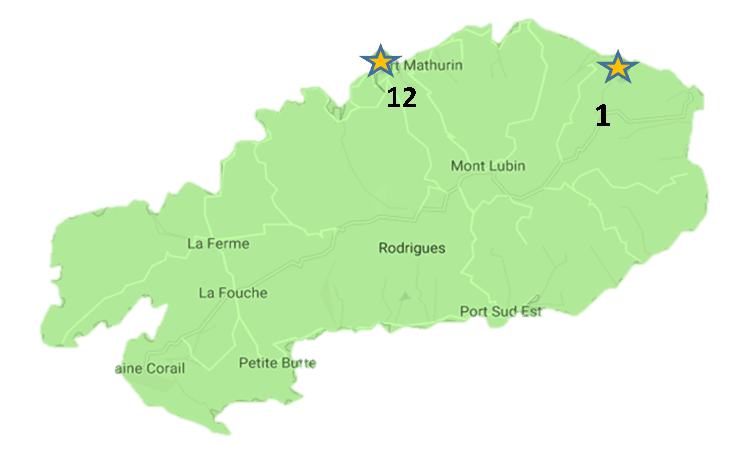
Energy autonomous solar stations have been deployed across 9 Sites in Mauritius, 2 Sites in Rodrigues and 1 Site in Agalega configured to measure instantaneous global horizontal irradiance (GHI), plane of array irradiance (PoA), ambient temperature and cell temperature with a sampling rate of one minute. The sites details are provided in the table below.
Site No. | Site | Country | Longitude | Latitude |
|---|---|---|---|---|
1 | Grenade | Rodrigues | 63.481° | -19.685° |
| 3 | Curepipe | Mauritius | 57.526° | -20.323° |
| 4 | La Mivoie | Mauritius | 57.364° | -20.345° |
| 6 | Ferney | Mauritius | 57.678° | -20.366° |
| 7 | Mahebourg | Mauritius | 57.708° | -20.408° |
| 8 | Souillac | Mauritius | 57.523° | -20.521° |
| 9 | Goodlands | Mauritius | 57.655° | -20.041° |
| 10 | Village 25 | Agalega | 56.618° | -10.387° |
| 11 | Rose Hill | Mauritius | 57.476° | -20.242° |
| 12 | Port Mathurin | Rodrigues | 63.423° | -19.682° |
| 13 | Nicolay | Mauritius | 57.513° | -20.152° |
| 14 | Bramsthan | Mauritius | 57.737° | -20.214° |
The station locations are mapped in the figures below.
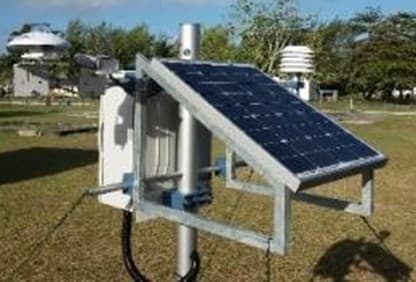
GHI values recorded using ISO 9060 secondary standard broadband EKO MS-802 pyranometers while PoA irradiance is measured using Si-O2-Pt mono-Si reference with integrated cell temperature sensor. Ambient temperature is measured with a platinum thermistor Pt100 1/3DIN (100 Ω at 0 °C). All the equipment was deployed in August 2017 and sensors at each station are connected to a signal conditioning element and a web-based data logger that transmits all measured data to a central server located at UoM. For more information on the network of sensors, system architecture, data collection, and data processing, the reader is referred to the work of Ramgolam and Chiniah (2019). The below figure illustrates the station set-up with a tilt angle of 20° facing North.
Importance of irradiance and temperature
Solar PV devices convert solar energy into electrical energy. The output of a PV cell/module is given by the product of the incident solar insolation and the PV cell/module efficiency. However, PV modules characteristics, such as efficiency and electrical parameters, are defined at Standard Test Conditions (STC) which is a standard set of reference conditions used for the testing and rating of PV modules.
STC conditions refer to:
- (a) PV cell temperature of 25°C
- (b) incident irradiance of 1000 W/m2 and
- (c) atmospheric air mass of 1.5.
In practice, the irradiance and temperature are spatial and temporal analogue variables. Thus, it may be inferred that the output power/energy of a PV module is dependent on incident weather conditions, more precisely irradiance and temperature. Therefore, for proper sizing of PV arrays, prevailing meteorological conditions are crucial to determine the impact of irradiance and temperature on the electrical characteristics of the system. Additionally, energy production from a PV system can be estimated from the product of the peak power rating and the peak sunshine hours. The latter refers to the number of hours corresponding to the equivalent of 1 kWh/m2 incident global horizontal insolation. More in-depth explanation on how irradiance and temperature impact the output of a PV module is available under the Learn section.
Acknowledgment
This research is a collaboration between the University of Mauritius (UoM) and Central Electricity Board (CEB).
It received grants funding from the Global Environment Facility (GEF), through the United Nations Environment Programme (UNEP) and the Ministry of Environment, Solid Waste Management and Climate Change, under the ‘Nationally Appropriate Mitigation Actions (NAMA) for Low Carbon Island Development Strategy for the Republic of Mauritius’ project.
The project for dataset creation and validation has been funded by the Lacuna Fund.
The project team also extends its gratitude to KiloWattsol and Solargis for the provision of datasets.